
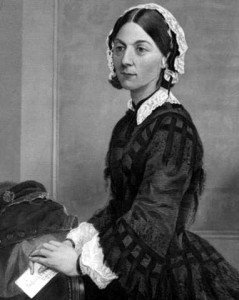
 Florence Nightingale – who is considered to be the founder of modern nursing – was born into an upper-class British family on 12 May 1820 in Florence, Italy. Her parents named her after the city of her birth.
Florence was also known as “The Lady with the Lamp” – a persona that became a popular icon of Victorian culture. The nickname originated from the nightly rounds she made, tending to wounded soldiers during the Crimean War. Her management and training of nurses during the Crimean War brought her to prominence and gave nursing a highly favourable reputation.
She was also a celebrated social reformer, statistician, and writer. Some of her achievements include: improving healthcare for all sections of British society, advocating better hunger relief in India, helping to abolish prostitution laws that were over-harsh to women, and expanding the acceptable forms of female participation in the workforce. Much of her published written work was concerned with spreading medical knowledge, writing many tracts in simple English so that they could easily be understood by those with poor literary skills, and popularising the graphical presentation of statistical data.
In 1860, Florence Nightingale laid the foundation of professional nursing with the establishment of her nursing school at St Thomas’ Hospital in London – the first of its kind in the world. The Nightingale Pledge taken by new nurses was named in her honour, and the annual International Nurses Day is celebrated around the world on her birthday.
Each year the International Council of Nurses prepares and distributes the International Nurses Day Kit. The kit contains educational and public information materials, for use by nurses everywhere. A service is also held in Westminster Abbey in London. During the Service, a symbolic lamp is taken from the Nurses’ Chapel in the Abbey and handed from one nurse to another, thence to the Dean, who places it on the High Altar. This signifies the passing of knowledge from one nurse to another.
This year the theme for International Nurses Day is: 2015 – Nurses: A Force for Change: Care Effective, Cost Effective
This theme resonates with commitment for action to change health systems around the world to achieve better health outcomes for all. In order to do this, nurses need an understanding of the landscape of healthcare delivery including financing, cost effectiveness and resource management, cost of healthcare, and access to care.
